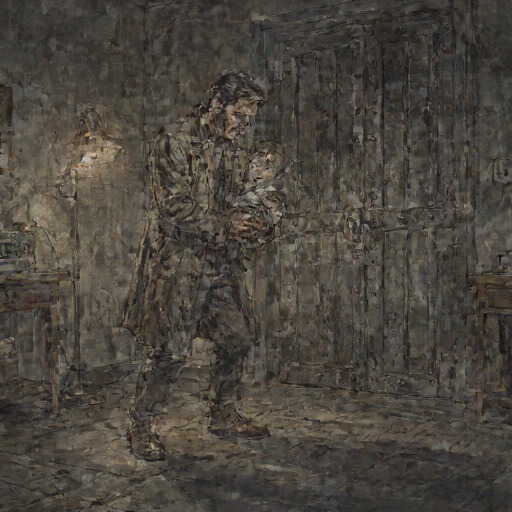
Penelope Stone
The Journey CollectionPenelope Stone is the emotional and domestic center of Travis McCoy’s return to Clarendon. Once the woman who owned his “heart and soul,” she was crushed when he left her, then spent a decade raising their son, Max, without revealing his existence. Her reunion with Travis converts his homecoming from a professional football player’s difficult return into a reckoning with love, parenthood, secrecy, and the family he abandoned without knowing it existed.
Identity and Background
Penelope is presented through Travis’s memory as the one person who believed he could accomplish anything he set his mind to. Ten years after their separation, she remains recognizable to him: she is about five and a half feet tall, with long honey-blond hair and brown eyes. The physical continuity matters because Travis’s return is not an encounter with an abstract memory; it is a meeting with the living woman whose absence has shaped his life. His recollection of her sitting beside him in the country car, making everything better, also exposes the intimacy and ease that existed before his departure.
Her history after Travis left is defined by an unwanted transformation into a young single mother. Penelope did not know she was pregnant when he departed. She discovered the pregnancy two months later, while her father was furious and her mother threatened Travis. She nevertheless tried to tell him. She drove to Austin, terrified, intending to explain what had happened, but found that Travis had already appeared to move on. His earlier insistence that they should see other people, so that temptation to cheat would not remain between them, convinced her that he had excluded a shared future from his plans.
Separation, Secrecy, and Parenthood
The secret of Max’s identity is not portrayed as simple indifference. Penelope admits that there was not a day during the decade when she did not pick up the phone or sit down to write Travis a letter, yet she never sent either. Her silence becomes a lasting moral burden: she acknowledges that nothing can excuse keeping their son from him, even while the narrative supplies the fear, family pressure, and emotional shock that sustained the decision. The result is a relationship shaped by a painful pursuit-and-withdrawal pattern: Penelope wants contact but retreats from the consequences of contact, while Travis demands the truth only after the lost years can no longer be recovered.
Penelope’s reunion with Travis occurs at the Clarendon High School gymnasium during the homecoming pep rally. Travis is signing a brown leather football for a boy when someone calls the name “Max.” Penelope appears in the doorway, sees Travis with the child, and reacts with anguish before pulling Max back into her arms. When Max calls her “Mom,” Travis understands that the ten-year-old boy is his son. The revelation makes Penelope both the guardian of the truth and the person forced to witness Travis’s shock. Her attempt to protect Max in that instant contrasts with Travis’s immediate demand for an explanation.
Afterward, Penelope describes the practical labor of raising Max. He was colicky during his first months, and her mother sometimes held him for an hour so Penelope could shower or sleep. Her parents helped with bills and childcare; later, she worked at the newspaper, covering subjects ranging from Lions Club dinners to the sports section. Her employer, Cory, allowed her to work from home so she could remain available when Max needed her. These details make motherhood a sustained structure of labor rather than a sentimental label. Penelope builds a workable life through childcare, employment, financial caution, and constant attention to her son.
Relationship with Travis McCoy
Travis’s return reopens both love and accusation. He resents that Penelope did not call or come to him, while she reminds him that he had made his priorities unmistakable before leaving. Neither can change the decision that created their decade-long separation. Their arguments are therefore not merely obstacles on the way to reconciliation; they are the means by which each person forces the other to confront the consequences of the past. Penelope’s tears and grief reveal that the secret has wounded her as well as Travis, but her admission does not erase the damage done to him or to Max.
The relationship begins to change when Max openly imagines that Travis, Penelope, and he can become a real family. Penelope is unable to answer immediately, but Travis promises the boy that they can. That promise places Penelope in a difficult position: Travis is claiming a family future before the adults have fully repaired the relationship that would support it. Even so, the moment gives form to the possibility that their separation has not permanently destroyed their shared life.
Travis eventually states his feelings publicly, telling Penelope that he loves her and never stopped loving her. He says that she was the first person he thought of during their years apart and that the thought of being away from her again frightens him. Penelope asks him not to say what he thinks she wants to hear, showing that reconciliation requires proof rather than romantic language alone. Travis answers by insisting that his love is real, and her tears as she turns her face into his hand mark the emotional release of a bond that has survived anger, silence, and time.
His commitment becomes concrete when he tells her that Max’s life, her newspaper work, and his developing reconciliation with Russ McCoy all belong in Clarendon. He refuses to make Penelope and Max follow his professional life elsewhere, instead promising to remain with them for as long as she wants him. When Penelope asks how forever sounds, Travis calls it a good start. Their exchange turns his return into an explicit choice: he is no longer treating family as a threat to his ambition but as the place where his future belongs.
Family Formation and Later Life
Penelope’s place in the restored family is confirmed through Travis’s decision to retire from professional football. Stewart Thornton tells Travis that his injured shoulder will never be strong enough for him to play again but offers him a coaching position with the Miami Sharks. Travis declines because he has discovered that his future is in Texas, with the family and loved ones who need him. Penelope is therefore not simply the romantic reward after a career crisis; her life with Max becomes one of the reasons Travis can redefine himself beyond the game.
Five months after finding Penelope and Max, Travis prepares a small black velvet box and proposes to her. He connects the proposal to a much older realization, remembering that he had loved her since he was fourteen and had understood, even in their earlier years together, that he needed her in his life. Penelope accepts with a single “Yes,” and Travis’s delighted physical reaction—standing, grabbing her, and spinning her around—turns the private proposal into a moment of shared joy. Marriage follows the restoration of trust as the next stage in the family’s formation.
Penelope’s family history also intersects with the McCoy family’s changing structure. At Loralie McCoy’s grave, Penelope tells Travis that every year on Max’s birthday she visits the black granite headstone and tells Loralie everything Max has done. The ritual shows that Penelope has preserved a connection between Max and the grandmother he never fully knew, even during the years when Travis remained absent. Later, Russ McCoy tells Travis that he intends to propose to Nadine, another sign that widowhood and grief need not end a family’s capacity for love.
By the later period of the story, Penelope is Travis’s wife and is expecting another child. When her water breaks, Travis immediately leaves his chair, reaches for her, and places one hand on her belly while asking whether she is all right. The scene reverses the conditions of their first family formation: the first pregnancy was discovered in secrecy after Travis’s departure, whereas this birth is met by a present husband who is physically and emotionally involved. Penelope’s labor therefore confirms the durable consequence of the reconciliation—the family is no longer organized around absence.
Narrative Role and Significance
Penelope functions as the novel’s threshold between Travis’s public identity and his private obligations. At the airport and in the professional football world, Travis is recognized as a celebrated player whose shoulder injury threatens his career. At the gymnasium, Penelope’s appearance exposes the personal history hidden beneath that public identity. Her presence reveals Max, forces Travis to confront the ten years he missed, and redirects the story from athletic achievement toward fatherhood and belonging.
She is also a round character because her choices contain a sustained contradiction. She is capable of deep loyalty and practical care, yet she keeps a decisive truth from the child’s father; she wants Travis to know about Max, yet repeatedly stops herself from making contact; she loves Travis, yet refuses to let an apology or declaration erase the consequences of his abandonment. The story does not reduce her silence to either villainy or innocence. Instead, it makes her fear, guilt, labor, and desire part of the same difficult history.
Penelope’s arc follows the family’s movement through separation, secrecy, disclosure, reconciliation, engagement, marriage, and childbirth. Her decisive achievement is not merely recovering a romance. She preserves Max’s life through years of uncertainty, maintains a career that accommodates motherhood, confronts Travis with the truth, and finally accepts a future in which he must remain present. Through her, the novel presents family as something rebuilt through accountability and repeated acts of care rather than recovered simply because love has survived.